Are you a reptile enthusiast thinking of adding a new pet to your home? You’ll be spoilt of choices since several reptiles are known to offer great companionship. And if you’re a lizard fan, you might be overwhelmed by the different options available in the market.
Since you’ve stumbled on this site, it’s vividly clear that you have narrowed your options to bearded dragon and chameleon. These two lizards have unique features that make them perfect for many.
However, the only way you’ll be able to choose a pet that’s compatible with your lifestyle is to look at how these animals differ in their personality and individual requirements. If you consider things like habitat, temperaments, diets, cost, size, and life expectancy, you’ll be able to make an informed decision.
Luckily, we’ve done the heavy lifting and provided you with an ultimate guide to help unravel the showdown between bearded dragons and chameleons. We hope that when we conclude this piece, you’ll be able to select a lizard that’s perfect for your kind of lifestyle.
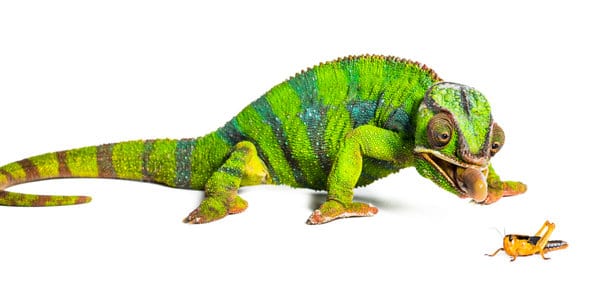
Bearded Dragons vs. Chameleons: The Differences
Straight into business, let’s look at how these two lizards differ.
Differences in Habitat
Chameleons and bearded dragons require lizard-friendly habitats for them to thrive. However, these two originate from two distinct backgrounds, and thus their terrariums have different requirements.
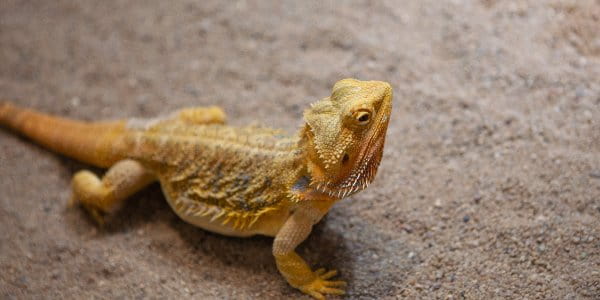
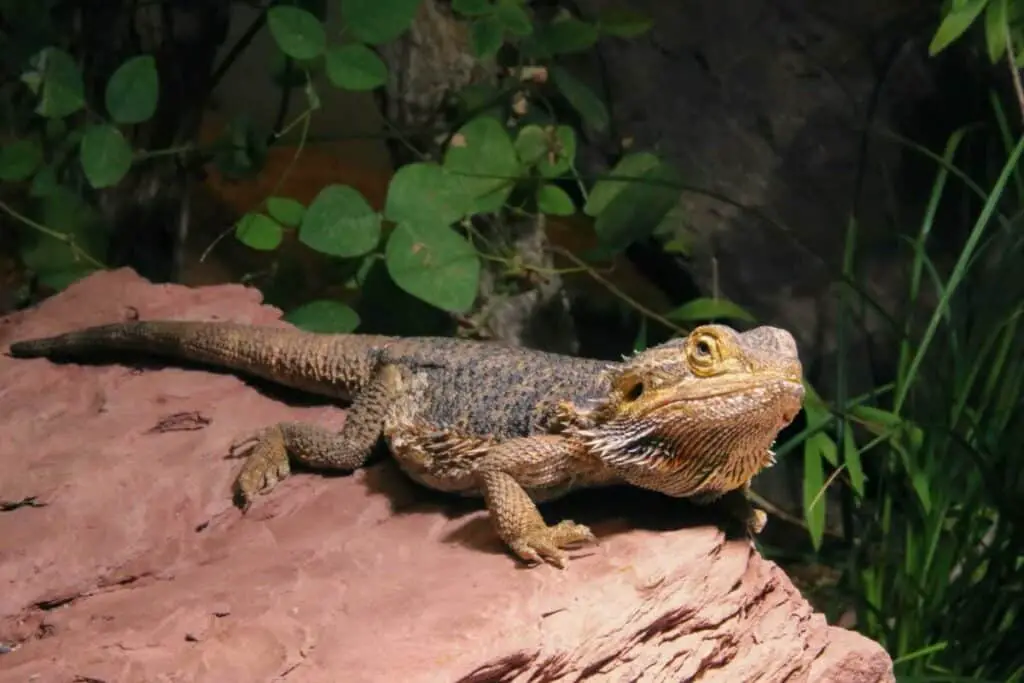
Beardies hail from the deserts of Australia and thus are used to high temperatures and low humidity. This means that the creatures can thrive in scrublands and subtropical woodlands. The animals are semi-arboreal and will only climb up to a certain height to bask.
On the other hand, chameleons are said to have originated from the rainforests and deserts of Africa. The creatures can change their colors for thermoregulation and to hide from predators. More importantly, their skin color says a lot about their living habitats.
For instance, brown geckos are usually synonymous with the desert environment. Conversely, having green skin insinuates that the chameleon most probably resides on trees. Chameleons are arboreal and are always seen climbing up and down.
Because of the different backgrounds, these are some of the areas where beardie’s and chameleon’s habitats are different:
Size of the enclosure
Being semi-arboreal, bearded dragons require enclosures that are extensive horizontally. This is because they spend a lot of time on the ground and only climb on rocks and low-branches to bask. Adult beardies can live comfortably in 75 to 120-gallon tanks.
On the other hand, chameleons are arboreal that enjoy climbing and moving around tree branches. Their enclosure must be set up to extend vertically to create more space for artificial or natural climbing plants. Simply put, chameleon enclosures should be taller, not wider. The tanks should have plenty of branches and leafy plants. Adult chameleons can live comfortably in enclosures that are four feet long, three feet wide, and four feet tall.
Heat and Temperature Range
Chameleons and bearded dragons require slightly different temperature ranges. The daytime temperatures in a chameleon’s enclosure should range somewhere between 75 to 85 degrees Fahrenheit. Nighttime temperatures should be around 65 and 75 degrees Fahrenheit.
Bearded dragons require a similar temperature range of 75 to 85 degrees Fahrenheit during the day. However, they need a higher temperature range of about 70 to 75 degrees Fahrenheit at night.
Both bearded dragons and chameleons require adequate UVB light and basking spots to speed their metabolism and facilitate optimal growth and development.
Chameleons need a heat source to maintain the temperatures at an optimal range of between 75 and 85°F. They also need 12 hours of exposure to UVB lighting.
Unlike chameleons, bearded dragons require basking spots to be hotter than the rest of the tank. More importantly, they need around 12 to 14 hours of UVB exposure. Depending on their age, the basking area temperatures should be maintained at about 88 to 100 degrees Fahrenheit. Because of the extra UVB exposure and additional temperature needs in the basking spot, bearded dragons will need more powerful heat and light bulbs.
Humidity
Humidity levels in a lizard’s habitat should be optimal for the creatures to be comfortable and breathe with ease. Surprisingly, chameleons and bearded dragons require distinct humidity levels.
Because chameleons are tropical lizards, their habitats should have an average humidity level of between 50% and 70%. However, this can differ based on the species you buy.
On the other hand, bearded dragons are used to desert conditions where humidity is relatively low. They require an average humidity level of between 20% and 40%.
Differences in Diet and Feeding Habits
Regardless of which lizard you take home, you’ll need to provide it with a proper diet. Essentially, bearded dragons and chameleons require varied diets, which need to be regularly spiced up to avoid boredom. Nearly all chameleon and bearded dragon species are omnivores in nature.
The food you should give your chameleon will be based on its species. However, most chameleons feed on both plants and animals. However, these reptiles prefer to savor insects such as grasshoppers, crickets, worms, and flies.
They also need to load up with some leafy greens to get essential nutrients. Their food should be spiked with calcium powder to encourage growth. Chameleons prefer to eat animal-based products than vegetables. Their diet primarily comprised 50% insect and 50% leafy greens. However, they are said to be picky with the food they consume.
Although bearded dragons are omnivores, they don’t relish meats as much as the chameleons. Their diets mainly comprise 70% plants and 25% insects. However, young beardies need a lot of proteins to accelerate growth and development.
The other difference between the two lizards is in the frequency of feeding. Younger lizards will always eat plenty of times because of their high energy requirement and increased rate of metabolism. However, the adult reptiles don’t eat as much.
Adult chameleon require at least one meal a day. You should ensure that they savor as much as possible in a single seating.
Bearded dragons don’t eat much and should only be fed after a day or two.
Insightful Tip: These two lizards will require supplements and vitamins for healthy and fulfilling lives
When deciding which lizard to take home, you’ll need to factor in the dietary needs and feeding habits.
Differences in Temperament and Behavior
Behavior and temperament are unique elements that help most owners determine whether to take home a bearded dragon or chameleon.
Bearded dragons have plenty of fascinating attributes that make them ideal for many. These scaly creatures are cute, docile, and easy to cater to. They are not quick to attack when they feel threatened. This makes them kid-friendly, although letting your kids play with bearded dragons is something that needs guidance and supervision.
Bearded dragons don’t adjust to new surrounding faster. So, if you take it home expecting it to show you affection immediately, you have the wrong lizard. However, you can train the beardie to socialize and create a lasting bond with it.
Luckily, when these scaly friends get comfortable around you, they allow you to stroke and pet them or even climb on your shoulder. However, like all the other reptiles, they won’t appreciate being handled too often. A well-trained bearded dragon can be your best companion.
Like the bearded dragons, chameleons also need time to learn how to socialize and bond with their owner. The training and learning process may take longer since chameleons don’t like to be handled, and most people are impatient. At its best, the only thing a chameleon can do to display affection is climb onto your hand and nothing more.
Chameleons are very territorial and aggressive to the other lizards and shouldn’t be kept in the same tank as other lizards. Additionally, they don’t like to be petted or handled. So, if you decide to buy a chameleon, it will be more suited for watching than handling.
Differences in Size
Chameleons and bearded dragons are almost the exact sizes. However, Chameleons are larger and heavier than bearded dragons. Adult beardies can measure between 18 to 26 inches in length. They weigh up to 1lb.
On the other hand, chameleons will grow up to 24 inches. They can weigh up to 4.4lbs. However, a fair amount of the lizard’s length comes from its tail. This explains why the creatures are extensive yet relatively light.
When deciding which lizard to choose between bearded dragons and chameleons, you should consider the size and weight since they determine how much space the creature will need.
Differences in Life Expectancy
Another thing you need to consider when making your decision is life expectancy. Some pet owners want a reptile that will provide companionship for the longest time possible. However, others don’t want to keep pets that live for so long.
When bearded dragons are adequately fed and well-taken care of, they can live anywhere between 8 and 15 years. Essentially, their life expectancy in the wild is 10 years. However, when brought into captivity, this may extend to 15 years.
In contrast, a chameleon’s life expectancy is between 3-8 years. It doesn’t matter whether it’s in captivity or the wild; the life expectancy doesn’t change based on improved care.
Experts claim that chameleons don’t like getting handled and are slow to bond with their owners because their life expectancy doesn’t extend even when taken into captivity. Additionally, the reptiles are aggressive to other animals and prefer to stay alone. Therefore, go for a bearded dragon if you’re looking for a lizard that will provide companionship for more than ten years. A chameleon is the best option if you want a reptile that won’t last for more than eight years.
Differences in Related Costs
The cost of buying and maintaining a lizard should also be a consideration when choosing between a bearded dragon and a chameleon.
A bearded dragon will cost you between $30 and $150 during the initial purchase.
This will depend on the species and whether it’s a baby bearded dragons, juvenile, or adult beardies. Apart from the initial buying cost, you’ll have to consider other expenses of housing the lizard.
Bearded Dragons will need the following in setup cost:
| Heating | $15 to $30 |
| Enclosure | $50 to $300 |
| Food & bath | $10 to $40 |
| Substrate or mat | $5 to $40 |
| Plant, rocks | $15 to $40 |
| UVB lighting | $30 to $50 |
| Thermometer and hygrometer | $8-$50 |
In contrast, buying a chameleon can range from $30 to $600, based on age, species, and gender. Pet owners will also have to incur other costs, such as:
| Tank/terrarium | $50-$300 |
| Food | $10 -$30 |
| Bedding and climbing plants | $60-$150 |
| Lighting | $40 -$120 |
| Digital thermometer and hygrometer | $8-$50 |
| Water Setup | $30-$50 |
Any aspiring reptile owner should buy their pet from a reputable breeder instead of pet stores. Although buying from a certified breeder may cost you more, you’ll have a guarantee that your reptile is healthy.
While the initial buying price may be decent, you should also consider the lifetime cost of taking care of the pet.
Some pets may be reasonably priced at the pet store, but it will cost you a fortune to cater to their needs throughout their life.
Bearded Dragon vs Chameleon: Pros and Cons of Each
Now that we have combed through the differences between these two reptiles, let’s now look at the strength and weaknesses of each.
Bearded Dragons
Pros
- They make great first time pets
- Affectionate
- Bearded dragons are kid-friendly
- They boast a manageable size
- They live longer than chameleons
- They come in multiple colors
Cons
- They are fragile
- They prefer live insects instead of dead ones
- They take time to bond with their owners
Chameleons
Pros
- Their numerous colors alteration make them attractive
- Easy to manage
- They are calm and collected
Cons
- 70% of their diet must be insects
- They don’t love being handled
- Not great first time pets
- Produce body odor
- Not ideal pets for kids
- Easily susceptible to stress
Which Among the Two Lizards is the Better Option?
As seen in our previous section, both bearded dragons and chameleons have advantages and disadvantages. Therefore, putting them side by side is like comparing apples to oranges.
While beardies come in multiple colors, are kid-friendly, and are easily sociable, chameleons taunt beautiful looks, are docile, and easy to manage.
The kind of reptile you choose to be your pet will be based on your tastes and preferences. You should only select a lizard that aligns with the needs of your lifestyle.
If it’s your first time and you’re looking for a docile reptile pet that you can lift and stroke, care for easily, or keep around kids, you should go for the bearded dragon.
However, if you’re not a beginner and want a pet that needs little upkeep and won’t mind being left alone without constant petting, you’ll never go wrong with a chameleon.
The baseline is that you must be committed and dedicated to providing your pet with the best conditions possible.
Do Bearded Dragons and Chameleons Get Along?
Sometimes, it may be daunting to know which pet to take home between a chameleon and a bearded dragon. For some reptile enthusiasts, the best decision is to bring both lizards home. However, you should ask yourself, do these two creatures get along? Can a bearded dragon and a chameleon live peacefully in the same tank?
Your goal is to offer the reptiles the best environment where they won’t live in fear or stress. So, it’s crucial to know whether the two creatures can get along before you take them home.
As seen earlier, bearded dragons and chameleons need different housing requirements. So, even if they can get along, they have to stay in separate enclosures.
Inherently most reptiles are solitary creatures that prefer living alone. For bearded dragons and chameleons, they extend the issue further by being territorial creatures.
When fully mature, these creatures won’t see eye-to-eye and won’t reside in the same tank since they’ll keep fighting for space. Therefore, keep each in a separate tanks.
Therefore, even if you decide to buy both the bearded dragon and the chameleon, you should never put them in the same enclosure. Their tanks boast different humidity, temperature ranges, and other essential conditions.
Bearded Dragon vs Chameleon – Frequently Asked Questions
Can a Bearded Dragon Live With a Chameleon?
Chameleons and bearded dragons will never live in the same place as they have different requirements. Bearded dragons hail from the harsh deserts of Australia, where temperatures are high and humidity is low.
On the other hand, chameleons originate from the forests of Africa, with a tropical climate where temperatures and humidity are standard.
Additionally, beardies are semi-arboreal and spend time basking on rocks and low-hanging branches. For this reason, they need tanks that extend horizontally.
This is contrary to chameleons which are arboreal and like to climb high on plants and trees. Their enclosures extend vertically to provide ample space for artificial or natural plants where the chameleons can climb.
Lastly, chameleons and bearded dragons are territorial animals and won’t take it lightly if another lizard is introduced into their enclosure.
Which Lizard Makes the Best Pet between a Bearded Dragon and a Chameleon?
If you are tongue-tied between choosing a bearded dragon or a chameleon, the truth is both reptiles have their pros and cons.
Bearded dragons are easy to care for, quick to socialize, kid-friendly, and live longer. Therefore if you want a reptile pet that you can massage and hold, the beardie is the best choice.
On the other side, chameleons don’t like to be held, but they are docile, less involving, and can change into many attractive colors. If you’re looking for an aesthetically appealing pet that you could watch instead of hold, the chameleon is the best bet.
Which is the Best Enclosure for a Bearded Dragon?
Before buying a bearded dragon, the first thing you should have is a cage. With thousands of cages being sold in the market, knowing which one is the best can be daunting. Essentially, the size of the cage is determined by the age of the beardie.
While bearded dragons can comfortably live in a 70 to 120-gallon tank, you should always go for the largest tank. The rule of thumb is that a tank should be three times the size of the beardie.
Should I Let My Reptile Pets Roam?
Letting your pet room freely outside their cages is a great way to let them exercise. However, you should make sure that they only roam in a controlled area and are supervised. You need to keep other pets like cats, monkeys, and dogs out of the area.
When beardies or chameleons are kept in the same place as cats, dogs, and monkeys, it will take a split second before the latter attacks the former and turn them into food.
Is Putting a Reptile in Captivity Being Cruel?
Most reptiles, especially the small ones such as turtles, chameleons, and lizards, are always at risk of predation when in the wild. Therefore, giving them a place to live comfortably and get adequate food is not in any way being cruel. Captivity offers reptiles that are always looking through their shoulders a chance to live in a safe and fully functional natural habitat.
The only time owning a reptile pet can be cruel is when you don’t take proper care of them or mistreat them.
Conclusion
Bearded dragons and chameleons are wonderful pets that will bring the best out of you if you provide them with the best care.
However, each animal has its personality, behaviors, and housing requirements. For this reason, the decision to either keep a beardie or a chameleon as a pet will boil down to individual preferences.
Bearded dragons are ideal for those who want a pet that likes to be petted and held. In contrast, chameleons make great pets for those who want to watch as the reptile switches to various colors without touching it.
If you were in a dilemma choosing between a chameleon vs bearded dragon, we hope this guide arms you with the correct information to enable you to make the most solid decision.