Opening the mouth means different things for different species. In fact, all creatures in the animal kingdom do it, including humans and fish. It’s thought that yawning helps in thermoregulation, but it’s not 100% definite.
As for beardies, this behavior is common, especially when the lights come on in the morning and when they wake up from a nap. To yawn, bearded dragons first puff out their head several times as if they are being aggressive, then open and close the mouth slowly.
So, what are some of the reasons why your bearded dragon is opening and closing its mouth? Read on to learn more in this guide.
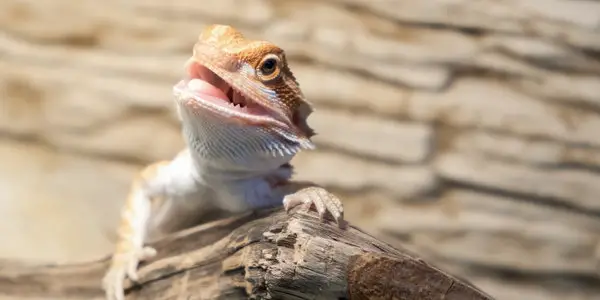
Why Do Bearded Dragons Open Their Mouth?
Bearded dragons open their mouth for several reasons. When it happens, it’s to regulate the body temperature most of the time. Sometimes it’s a sign of defensive behavior and aggression.
Read the reasons why bearded dragons open their mouth:
1. Gaping for Temperature Regulation
Lizards do not sweat like humans and thus cannot regulate their body temperature through sweating. A beardie’s way to cool down is by gaping or opening its mouth for some time.
The technique is known as gaping, which helps them vent the excess heat from their body, therefore keeping the temperatures optimal. Sometimes, the dragon will stick the tongue out to reduce his body temperature further.
Most of the time, bearded dragons will gape while basking, which means they will do it while sitting on a rock under a heat lamp.
If the gaping is happening in other areas of the tank, then you need to investigate whether the tank is too hot and ensure there are cool spots where the bearded dragon can cool down.
A beardie’s terrarium needs to have cool and hot spots as these allow for cooling down and heating up as required.
2. Beardie Stretching
As the name suggests, bearded dragons have a beard around the neck, which they puff and sometimes change the color or the intensity of the color. The scenario looks like choking to the unprepared witness, while others might describe it as demonic possession.
Sometimes what is seen as stretching his beard means they are defending themselves. Sometimes the intensive reaction is not aggression but just stretching in the form of yawning.
3. Aggressive Behavior
Every bearded dragon owner knows these lizards as very friendly, placid, and calm. They usually get along well with their owner without biting and can take to strangers too. However, if they feel threatened, they can appear aggressive and defensive.
Fortunately, they acknowledge humans, so they rarely act aggressively towards us. When they turn aggressive, though, they respond by puffing and darkening their beard and opening their mouth to try and intimidate whoever is threatening.
Although aggression is rare, it may be accompanied by other behaviors like hissing, charging, and sometimes biting.
If you think your beardie opens its mouth to show defensive behavior toward you, it’s a sign that you need to make the cage safer.
You could get some plastic plants and place them near the sides of the enclosure. This allows the beardie to hide when it does not want to interact and will likely help curb aggression.
4. Feeling Threatened
Sometimes bearded dragons may get startled by other bearded dragons in the cage or just other creatures. Sometimes two males in the cage may react aggressively toward each other. This can startle other beardies in the cage, who may react by hissing and opening their mouth.
If the room has other pets approaching the cage now and then, making noise and attempting to bat the cage, all these may scare the beardie.
If the bearded dragon’s cage is close to the window, they may be seeing birds causing them to open their mouth. It could even be a noisy passing car or the neighbors’ aggressive dog scaring the beardie.
If these are the causes, try to look for a quieter area to place the cage away from the window.
5. Respiratory Infection
A major cause for concern if the beardie has his mouth open for extended durations is a respiratory infection. This occurs when the humidity levels are high for too long, making the dragon breathe moist air. The solution is to reduce the moisture levels in the tank.
This can be done by keeping the water bowl away from the heaters to reduce evaporation and remove any moisture-retaining materials like barks and absorbent clothing.
It’s advisable to ensure the moisture level does not rise above 40% at any time. Signs to look for if you suspect your beardies have a respiratory infection, include excessive gaping and mucus around the mouth.
If the infection worsens, the beardie is likely to become lethargic and may need a vet’s assistance to stop it immediately. Left unattended, the wheezing will worsen as fluid builds up in the lungs and eventually suffocates the beardie.
6. Slack Jaw
One of the initial signs of metabolic bone disease is when the beardies keep their mouth open and won’t hang onto food. When your beardies keep the mouth open without closing it, you should see a reptile vet immediately to test for MBD.
FAQs
Why is My Bearded Dragon Sleeping With His Mouth Open?
It’s weird when a beardie sleeps with his mouth open. When this happens, it’s probably just an unusual quirk of an individual beardie.
It could also be that the enclosure is too hot during the night, forcing the beardie to gape (while asleep). Make sure that the nighttime temperature is low, ideally below 75C, especially around their area of sleep.
Wrap up
So, can beardies yawn? Beardies open their mouths for many different reasons. It’s probably gaping most of the time, which is a good sign that the basking spot is hot enough (as long as there’s a cool spot).
Sometimes, it can be a sign of defensiveness or illness. Pay attention to your dragon’s mental behavior to distinguish the good and the worse.