Tortoises are land-dwelling turtles and belong to the order of Testidunes. There exist over 50 tortoise species across the world, and these animals are found in most places other than in Antarctica and Australia. Most turtles are aquatic and semi-aquatic, meaning they can survive in water. But what about tortoises? Can tortoises live in water, and how?
Can tortoises swim?
No, tortoises can not swim. Unlike sea turtles and terrapins, the body of a tortoise lacks the necessary adaptations for swimming. However, tortoises can float only for a specific duration in some cases in still waters.
Tortoises spend a significant amount of their life on land. Because of the shells they bear, some people confuse tortoises with turtles. It can be a costly mistake when people try to put a tortoise in water, thinking they are rescuing an aquatic or semi-aquatic turtle. Even when this is for a well-meaning cause, the tortoise might end up losing its life because it can’t swim to save itself.
Why Can’t A Tortoise Swim?
Swimming in humans requires particular skills, but it is mainly about the body structure for turtles and most animals. Aquatic and semi-aquatic turtles have specific adaptations that make moving and surviving in water easier. But what about our hard-shelled terrestrial species? Why can’t tortoises swim? Let’s have a look at the reasons why tortoises can’t swim.
1. Shell
One of the most distinctive features of turtles is their hard shell. It is a vital body organ that aids the survival and well-being of these animals, and they can’t survive without it. Turtles’ shells differ in color, patterns, and shape depending on the species and habitat.
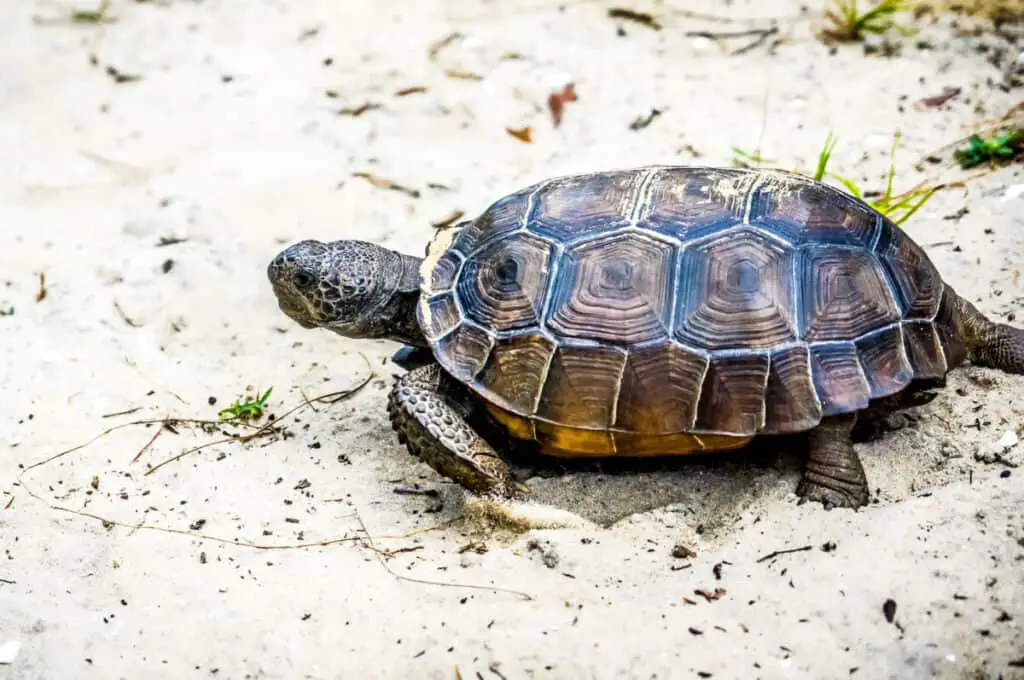
Tortoises have a high domed shell with a rough outer surface. On the other hand, the other turtle species have a more flat and smoother shell. The shape of the shell allows the tortoise to retract fully in the shell if under threat. It plays this vital role as tortoises are slow-moving and can’t run to escape a predator. In addition, the roundness makes it easier for a tortoise to get back on its feet if it falls or rolls over.
While the shape of the tortoise’s shell is vital in its survival, it is also part of why a tortoise cannot swim.
The high-doom means that a tortoise does not have the streamlined body necessary for swimming. It makes it harder for the reptile to move in the water. In addition, the rough outer surface creates more resistance with water if a tortoise was to swim.
Turtle species that can swim have a smoother outer shell surface.
2. Feet and Flippers
Sea turtles’ limbs are flippers, while freshwater turtles’ limbs are webbed. These feet adaptation allows these turtles to swim in the water. They use the limbs as paddles to effectively move in water by propelling their body forward with the front limbs and using the back ones to push water behind. As such, turtles and terrapins can seamlessly swim in either direction irrespective of water depth.
When it comes to tortoises, their feet are neither flippers nor webbed. A tortoise has flat forefeet and gigantic rear feet. These feet also have claws and appear bent.
The structure of the tortoise’s limbs may seem like a disadvantage, but it is necessary for the tortoise’s survival on land. The forefeet are flat to help them quickly dig deep burrows for aestivation in the desert. Big hind limbs support their body weight and enable them to rise when retracting from the shell or after resting.
A tortoise can’t swim because its feet do not adapt to swimming. They lack flippers or the web-like shape required to thrust the body forward and push water behind when swimming. However, webbed feet or flippers would make it hard for tortoises to move on land. For this reason, most tortoises are faster on the ground than turtles and terrapins.
3. Environment
The natural environment plays a role in the features the animal possesses. Often, these features grow or evolve as an adaptation for the effective survival of the animal in its natural environment. Aquatic turtles hatch on land but grow in the water; therefore, they can swim.
Tortoises are terrestrial, and they spend most of their lives on land. Their bodies have adaptations that make survival and moving on land easier, but not in water because they do not need to as that is not their natural environment.
Therefore, tortoises can’t swim because their natural habitat is on dry land, and their bodies have adaptations for a more comfortable life on land. Unfortunately, the land survival features do not support swimming in water.
Can Tortoises Drown?
Now that we know that tortoises can’t swim, what happens if they accidentally fall in the water? Would a tortoise drown, or would it learn to swim to save its life?
A tortoise will most likely drown if put in water. It might survive, but the major likelihood is that it will drown, especially if left in water for long. Tortoises are born as terrestrial reptiles with no swimming adaptations, so they have no swimming instincts to kick in when put in water. Even if they had swimming instincts, a tortoise’s body lacks streamlining, so they would not swim.
Even so, a tortoise might survive if you place it gently on top of still water. If it can remain afloat, the tortoise may drift towards the edges of the water body and get out. But not all tortoises have the ability to stay afloat even in still water. Older and heavier ones will most likely drown faster than younger and lighter ones.
If a tortoise drowns in water, it may suffer from either ventricular fibrillation or anoxia. The former is a condition where the reptile’s heart beats abnormally in a non-even rhythm leading to blood not flowing in the body. Anoxia is another possible effect of a tortoise sinking, whereby the body lacks oxygen because the lungs are full of liquid. Both conditions are severe and can make the tortoise die.
It is important not to put tortoises in water. Doing so puts their life at risk and may lead to fatalities. There have been cases of people putting tortoises in water, mistaking them for terrapins and sea turtles.
To avoid making a mistake, familiarize yourself with the differences between turtles and tortoises. One of the most significant is the shape of their shells; it is more flat and smooth in turtles, while in tortoises, it forms a high doom and is rough. The limbs of a turtle are also webbed of look like flippers, while those of a tortoise and huge with no webs.
How To Keep Your Tortoise Safe Around Water
Although tortoises can’t swim, it doesn’t mean that they don’t interact with water at all. In the wild, tortoises can, at times, be seen cooling off at the shores of a water body on a sunny day. They also need water for hydration and other body functions. Here are tips on how to keep your pet tortoise safe near water.
1. Drinking Water
In the wild and especially in the desert, tortoises mainly get their hydration from water and drink it when accessible. Although their bodies are adapted not to need a lot of water, it is still necessary to ensure that your pet is well hydrated.
Provide the pet tortoise with access to clean water. The water basin should be shallow to ensure that your pet does not drown. Because pet tortoises often chill near the water, ensure to change this water daily to avoid contamination.
2. Tortoise Baths
Tortoises like to cool off near water bodies. In captivity, it is essential to give your tortoise occasional shallow baths. It helps with hydration, hygiene and is an effective way of bonding with your pet. Put the tortoise in a shallow sink or basin and add water to a level below their heads.
Ensure that your pet tortoise does not drown during the baths, ensure that the water levels remain low, preferably at around one-inch depth. The rationale is that should your pet tortoise decide to lay down its head, it will not submerge.
In addition, do not leave the tortoise alone when in the water. It might flip and end up dying if you don’t turn it back quickly. Another tip is to use lukewarm water to prevent burns on your pet. Once done, pat the tortoise dry and return it to its enclosure.
3. Proof Open Water Bodies
If you have an open pool or pond, it is a potential hazard, especially if you let your tortoise roam around without supervision. The tortoise may wander and get too close to the water body. While the tortoise instincts will not make it jump into the water, it may accidentally fall.
Ensure that you supervise your tortoise whenever you let it explore outdoors. If not, it would be best to proof your pool and pond with strong enough and closely-knit barriers to prevent the tortoise from falling into the water.
How To Save A Drowning Tortoise
We have seen that tortoises can’t swim to save their lives. Even when they remain afloat, it is only for a specific duration before they start drowning if help doesn’t come sooner. The above tips will help you keep your pet tortoise safe near water, but what if your pet tortoise accidentally falls in a pool of water? What should you do when you spot a drowning wild tortoise?
When you find a drowning tortoise, the first thing to do is immediately remove it in water by holding it upright and not upside down. A sinking tortoise swallows a lot of water, which affects its lungs’ function, resulting in anoxia. Place the turtle in a safe place.
Depending on how severe the drowning is, the turtle may exhibit drowning symptoms such as a declining pulse, unconsciousness, or its body parts turning blue due to lacking oxygen.
The next step is checking to ensure that the turtle is not dead by checking reflex. A turtle under threat will instinctively tuck in its head, tail, and limbs, even in the face of death. Use a blunt object or pencil to poke its back limbs and see if it retracts into the shell.
If unresponsive, immediately call a vet or rescue center to ascertain if the turtle is dead. If the turtle responds by tucking in its protrusion, then the next step is opening the turtle’s mouth while holding it upright and pressing its flanks. It helps remove water from the body and thus aids breathing and oxygen circulation.
Next, gently move its front limbs back and forth to imitate its body’s natural movement when breathing. You might need help to do this. The back and forth action force its lungs to compress, moving water from the lungs and mouth.
If the process seems to yield, continue until the tortoise starts breathing effectively. While some may start breathing right away, others may take hours to start doing so. It may also be best to call an exotic vet while still trying to save the drowning tortoise.
How Long Can A Tortoise Float
Some tortoises can float in water, but some can’t. The ability to do so is most dependent on the tortoise’s age, weight and species. In addition, the stillness of the water body also affects this as a tortoise that will most likely not float in quick flowing water.
If the water is still, the tortoise can remain afloat and drift towards safety where they can climb out of the water. The air in its body also helps it stay afloat for longer. All other factors on how long the animal will float in water depend on its luck.
In general, a floating tortoise can stay afloat for an average of three minutes. If not assisted, it will start to drown and will not get back onto the water surface on its own. Beneath the water, a tortoise may survive for around 45 minutes. It does so by holding its breath for as long as possible after which, the water getting into the body will affect the lungs.
Frequently Asked Questions
Can A Tortoise Survive Underwater?
A tortoise can’t survive underwater. Unlike sea turtles and terrapins, tortoises cannot breathe inside water. They cannot hold their breath beneath water even for a few minutes because their lungs do not have the necessary adaptations. The tortoise will eventually drown if left underwater for long.
As such, you should not leave your pet tortoise near water that is deep enough for it to submerge.
Why Can’t Tortoises Swim While Turtles Can?
Tortoises are a category of turtles, but not all turtle species are tortoises. People often use the term turtles to only refer to the aquatic dwelling turtles, but the term also includes the land-dwelling species.
Turtles have a streamlined body meaning that their shell is flatter and smoother to reduce friction when moving in the water. In addition, their limbs are either webbed or have flippers for swimming. Turtles lungs also have features that enable them to hold their breath in water for several hours. Tortoises are unable to swim because they lack these swimming adaptations.
Do Tortoises Like Swimming?
Tortoises cant swim. They often avoid water bodies in the wild, only chilling by the sides to cool off during scorching weather or dipping slightly to freshen up.
In captivity, pet tortoises enjoy warm baths. You may also spot the tortoise dipping in the drinking water. Ensure that you only use lukewarm water and the water level remains at low levels during baths. In addition, your tortoise should not be left unattended in the water as it may end up drowning or flipping.
Are Tortoises Born Swimmers?
Tortoises are not born swimmers. Even baby tortoises have a high doom shell with a rough exterior. They are also born without flippers, and their feet do not have a web design. As such, tortoises are born without the features, a turtle requires to swim.
All turtles hatch on land. While the aquatic species head to water bodies after hatching, baby tortoises roam on land. If a baby tortoise accidentally gets into a pool of water, it will most likely drown. Its lungs are smaller, so it will not hold its breath longer than a mature tortoise would.
Conclusion
Tortoises are peaceful, docile animals with a unique appearance. While their aquatic and semi-aquatic counterpart species can swim, tortoises cant. Their body physiology does not make it possible for them to swim.
If a tortoise gets in flowing water, it will most likely drown. If the water is still, the tortoise may remain afloat for some time and hopefully drift ashore before it is too late. It is essential to ensure that you identify whether the Testidune you just found is a tortoise or turtle. It will ensure that you do not end up putting a tortoise in water where it will most likely drown.
As the owner of a pet tortoise put preventive measures to ensure that your pet is not at the risk of drowning. Tortoise proof your open water bodies, never leave the tortoise without supervision during baths and provide a shallow drinking water basin.