If you own a leopard gecko, you probably understand that these scaly creatures are mostly active at dusk and dawn. However, evidence suggests that these lizards haven’t always been like that. They used to be diurnal but had to learn to maneuver in the dark to survive harsh conditions and predators in their natural habitat.
However, one thing that most people want to know is, do leopard geckos see in the dark? And the answer is yes! Leopard geckos have a profound vision that allows them to see extremely well in the dark. Since these lizards are primarily crepuscular, they must have good vision under low light. These creatures boast more developed optical systems that allow them to hunt prey, avoid predators, and seamlessly navigate terrains even when it’s pitch black.
Don’t stop reading if you want to understand everything about the leopard gecko’s night vision.

Does My Leopard Gecko Have Night Vision?
Leopard geckos are among the animals that boast clear night vision. They see better in low-light settings than we can probably realize. These lizards boast superior night vision than us. Experts and documented publications indicate that their eyes are 350 times more sensitive than human eyes in the dark.
Leopard geckos boast a cone-shaped retina that is highly sensitive to light, even at night. Their superior vision allows them to see more clearly at night and have an advantage over other animals, including predators. Night vision is an integral evolutionary feature that allows these lizards to survive in the wild.
Since geckos are nocturnal, their eyes have multiple cones and rods, which split light into many colors, making it possible for them to see objects at night. They also boast opsin proteins that enable them to visualize higher UV wavelengths at night.
Some Insights into Leopard Geckos’ Night Vision
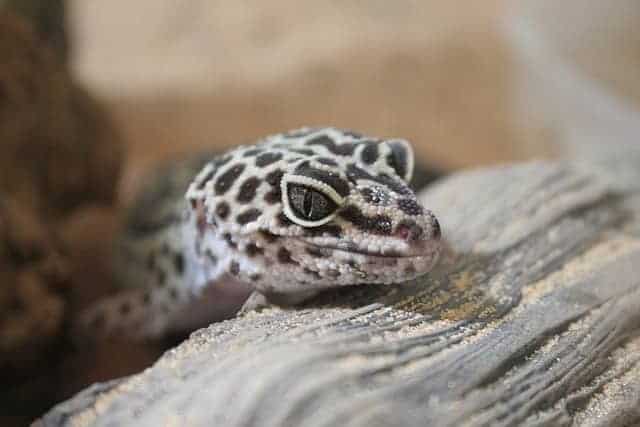
Looking at your scaly friend, you can guess it has excellent night vision. The leopard gecko’s cat-like eyes are a good indicator of good night vision. Generally, the pupils of nocturnal lizards are bigger and only narrow down the slits when exposed to excessive light.
In the wild, it’s normal for leopard geckos to remain active when the sun goes down than during the day. However, if you observe your scaly friend with a night vision camera in captivity, you will notice that its pupils extend to cover nearly the whole eye to let in as much light as possible at night.
How Leopard Geckos Evolved and Started Seeing at Night?
With cat-like eyes that feature pupils that widen in the dark and constrict in excessive light, leopard geckos are well adapted to see at night. Although leopard geckos are inherently crepuscular, documented evidence indicates that this has not always been the case.
Essentially, all lizards were diurnal and used to handle their business when the sun was out and slept at night. Like other diurnal creatures, their eyes had double retinas that featured rods and cones.
Cones and rods are photoreceptors eye cells that operate counter-currently. The cones come into action when there is too much light. On the other hand, rods are responsible for vison when there’s less or no light.
Because of spending more time in brightness, lizards developed more cones. However, others, like leopard geckos, decided to switch and became more active at night. Because the rods had somehow decreased, they had to develop more cones to improve night vision.
And to the surprise of many, leopard geckos’ cones became more sensitive and sophisticated. Because of these photoreceptor eye cells, geckos can see color and visualize things precisely, even when there is low light.
However, leopard geckos didn’t decide to be active at dusk or dawn for no reason. The lizards come from the hot deserts where day temperatures can be unbearable.
Conversely, since leopard geckos catch their food by hunting, they discovered that they placed themselves in danger by hunting during the day when most predators are active.
In response, they minimized their daytime activities and started being active in the mornings and evenings. One of the things that had to evolve to resonate with their newly found lifestyle is their eyes. Today, leopard geckos boast superior night vision than most animals and humans.
While their eyes have larger pupils to absorb more light, the large pupils come as a trade-off for optimal focal length. Because of pupil adjustment, these creatures can’t focus on objects more clearly when there is too much light.
However, their eyes are still evolving, with experts claiming that they have developed multifocal lenses with three distinct reflective capabilities. The three zones collectively enhance image processing and focus in geckos.
Do Leopard Geckos Need Light in their Terrariums?
Now that we know that leopard geckos can see clearly in the dark, do they really need light in their tanks? Your leopard gecko may have superior night vision than most animals, but they still need light to maintain a natural clock.
Yes, these lizards can see in the dark, but they won’t be able to know when to nap or when to feed if their terrariums are dark throughout. Like in their natural habitat, your leopard geckos’ tanks should maintain the day and night cycle.
You can illuminate your leopard gecko’s cage by placing a light source in the tank. Overhead lights look more natural and are safer than heating rocks or heating pads.
Can Leopard Geckos See Color in the Dark?
Another surprising fact about leopard geckos is that they can tell the difference between colors at night. These creatures can visualize dark blue, green, and violet hues, as concluded by various experiments carried out in controlled environments.
Other than being unable to see at night, human beings can’t tell colors apart when it’s dark. However, because of being crepuscular for an extended period, leopard geckos’ eyes have become more effective in seeing colors and objects when pitch black.
Lizard gecko eyes boast photoreceptors that simultaneously pick up light transmissions and decipher colors. This is the main reason they can visualize objects clearly and see various colors at night.

Will My Leopard Gecko See Feeder Insects at Night?
Night vision in leopard geckos is not a fairy tale. These creatures can actually catch insects once they are introduced into their terrariums at night. If you place some feeder insects in the tank and install a night vision camera, you’ll be surprised to see your leopard geckos capturing them more accurately than they do during the day.
When you place insects in the terrarium at night, your leopard gecko has the upper hand since it can see them. Unlike during the day when insects can run and hide, it will be difficult for them to evade your leopard gecko.
This is why you must feed your leopard gecko early in the morning before the sun rises or late in the evening when the darkness is creeping in.
Should You Add red Light to Help Leopard Geckos See in the Dark?
Typically, pet owners use red lights in their pet cages at night. However, since geckos are crepuscular, adding light in their cage at night doesn’t make sense. Although your leopard gecko won’t see the red color from the red lamps, their eyes are highly sensitive and will be able to pick the light spectrums.
And since they are used to dark conditions in their natural habitat, adding red lights in their tank will likely affect their night/day cycle. You should only provide light during the day if the terrarium isn’t receiving natural light. However, ensuring that the cage has optimal heat at night will reduce stress and improve comfort.
Why Is It Necessary for Leopard Geckos to See in The Dark?
If you may ask, why should a small creature like a leopard gecko have such prominent night vision? Seeing clearly in the dark helps leopard geckos in two ways; feeding and safety.
As we’ve mentioned countless times, leopard geckos are crepuscular, meaning most of their operations are done in low-light settings.
These lizards are opportunistic hunters that can feed on insects, invertebrates, and small and helpless animals. The creatures rely on their superior eyesight to spot, hunt and capture prey in the dark.
Additionally, having sharp night vision and being able to discern colors at night helps them spot predators, especially those that try to camouflage themselves.
Their ability to magnify the little light available in their environment enables them to hunt and stay safe in their natural habitats. This behavior is replicated in captivity and can be vividly seen by placing a night vision camera in the cage.
Final Thoughts
So, if you’re there wondering whether your leopard gecko has night vision, you can bet that these scaly friends can see clearly at night.
Although the spotted reptiles were initially diurnal, they had to adapt and evolve to stay safe and get nourishment without fearing for their lives.
Therefore, as a matter of fact, leopard geckos boast truly unique eyesight. Their eyes have advanced photoreceptors that allow them to see the world differently.
We hope this guide has given you a comprehensive understanding of the leopard gecko’s night vision and how their eyes have evolved.