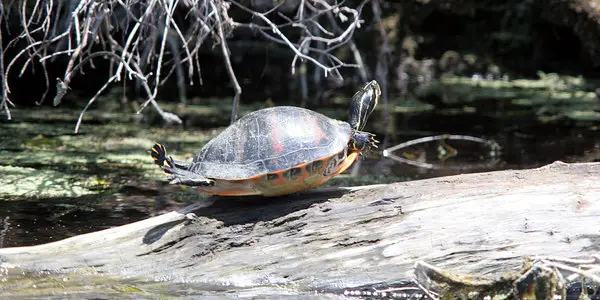
Turtles live a quiet life, and their anatomy is intriguing. These reptiles have a hard shell covering them. They also frequently bask under direct sunlight access in the wild and a heat lamp in captivity. It is vital to their health. In addition, turtles love to sleep, and good sleep is equally vital for them.
If you have a pet turtle, you might have noticed that it sticks its legs out when basking or when sleeping. You might have also noticed that the turtle is regularly kicking back legs. It is understandable for you to wonder whether this is something to be worried about and why your pet is doing this. Below we discuss reasons why your turtle is sticking the legs out when basking and when sleeping and also why it is kicking its back legs.
Reasons Your Turtle Is Sticking Its Legs Out When Basking
If you have a new turtle, you might find it strange that the pet sticks its legs out when basking. Even if you have had the turtle for a while, observing this as a new behavior can be a little worrying. Here are the common reasons your turtle might be doing this when basking.
1. Lack of Heat
These hard-shelled animals are cold-blooded reptiles, and they rely on the heat from their environment. For this reason, pet turtle owners need to provide these reptiles with a heat lamp in captivity.
These creatures get the heat in the wild by basking in the sun. During cold seasons such as winter, they hibernate as they can’t access the external heat source.
The absence of enough heat can make your turtle stick out its legs to increase the surface area being covered by the heat coming from the lamp. As such, the turtle can collect as much heat as possible to cover the deficit.
Check the temperature of the lamp and ensure that it is appropriate. Different turtle species have varying basking temperature needs. Verify that the basking lamp is producing is right heat amount for your turtle species. If not, adjust it accordingly to ensure that your turtle gets the right warmth amount.
It is tempting to increase the temperature above the turtle species’ needs, but this will only discourage it from basking. Stick to the recommended basking temperature.
It may also help to change the wattage of your bulbs. Depending on how close you place the heat bulb to the basking spot, it might not be powerful enough for the turtle’s warmth needs. Most bulbs come in wattage of either 50W, 75W, or 100W.
A low-wattage bulb that is too far from the basking spot is less likely to produce sufficient heat. Ideally, 50W bulbs should be 6-8” above the basking platform, and 75W ones should be 7-9” away. As for a 100W, the ideal position is 9-11” above the basking area.
2. Lack of UVB Light
UVB light is necessary for turtles and most reptiles because it helps with Vitamin D3 production. This vitamin is essential in helping them get the right calcium amounts. If the turtle suffers from calcium deficiency, it becomes more prone to metabolic bone diseases, improper bone growth, shell rot, and softshell, among other diseases.
Some bulbs produce both UVA and UVB light, but the two are distinct. While the bulb might still be emitting light, it might no longer be producing UVB rays, and thus, it is important to verify from time to time.
Purchase a UVB light for your turtle to try to stop it from sticking out the legs. If you opt for the fluorescent lamps that produce both UVA and UVB, frequently repace it just in case it runs out of UVB rays.
3. Resting
Your pet turtle might also stick its legs out when resting and relaxing. If you verify that the temperature is right in the tank and the UVB light source is working, then your turtle might just be exhibiting this behavior as a form of relaxation.
Turtles that have lived in a particular habitat for a while will get comfortable with the environment and feel safe. It is unlikely that a turtle in a new habitat will just lay down to rest and relax. They are tense, but this gets easier as they get accustomed to the new habitat.
If the turtle stretches out the legs to relax, do not panic. It is normal and okay.
4. Pregnancy
Female turtles exhibit various pregnancy symptoms. Among them is stretching the legs to stretch the now fuller body because of the eggs. If you already know that your turtle is pregnant, don’t worry if it exhibits the legs stretching mannerism; it is perfectly okay.
Even if your female turtle is alone in the enclosure, it can still get pregnant. The only difference is that the eggs it will lay will not be viable because male fertilization did not occur.
Other signs that your turtle might be pregnant include losing appetite to the extent that the turtle stops eating, not basking frequently or completely, kicking things, and increasing aggression.
Reasons Your Turtle Is Sticking Its Legs Out When Sleeping
Turtles have different sleeping habits. But a common factor in all is that turtles enjoy a good sleep. Although they don’t sleep for as long as humans do, i.e., 8 hours, they still like sleeping. On average, most turtles sleep for about 2 hours.
Some turtles sleep with their limbs stretching out. If yours has been doing this, then that’s perfectly okay. However, if it is a new observation and your turtle used to sleep with the legs tucked in the shell, you need to find out why. Here are the main reasons your turtle is sticking all limbs out when sleeping.
1. Low Water Temperature
Aquatic turtle species sleep in the water. Others may sleep in the basking area of floating on the water surface. The choice of where a pet turtle sleeps depends on how comfortable it feels. Your turtle may stick to the same sleeping area or change it from time to time.
If your turtle is sleeping with the limbs stretching out, there’s a chance that the aquarium temperature is too low. It will stretch out the legs to increase the heat its body collects to raise its temperature. Appropriate body temperature in a turtle enhances metabolism while improving the digestive and immune systems of the reptile.
The ideal aquarium temperature for most turtle species is 70 – 80 degrees Fahrenheit. It may vary slightly depending on your turtle species, but not too far from this.
2. Other Reasons
If the turtle has the right water temperature and still stretches the feet when sleeping, then it might just be relaxing or pregnant. As discussed above, you have no control over these reasons but are not alarming.
Reasons Your Turtle Is Kicking Back Legs
Another strange behavior turtles may have is kicking their back legs. Several factors may contribute to this behavior, and as a pet turtle owner, it is good to familiarize yourself with the same.
1. Stress
Like humans, turtles do get stressed, and the same factors that can stress a human may equally stress a turtle. These reptiles may seem hardy, but they can get stressed pretty easily. Some of the major factors that stress them include poor handling, an unclean environment, bullying from other turtles in the enclosure, loud music, and poor living conditions.
A stressed turtle may show signs such as kicking its back legs. It may also fail to bask, eat and hide in the tank.
Identify the primary cause of stress for the turtle and eliminate the same. It will relieve your turtle from stress and help it live a fulfilling life. Moving it to a different room might be best if the turtle is stressed due to frequent interactions. Observe its environment, control any suspected stress source, and observe if it stops kicking its back legs.
2. Inappropriate Temperature
If the water or basking temperatures are not right, the turtle might kick its back legs. The ideal solution to this is similar to the above, where the turtle stretches out its legs.
According to the turtle species needs, provide the ideal temperature for both the aquarium and basking area. The basking area temperature should be about 10 degrees Fahrenheit above the water.
3. Bullying
If you have multiple turtles in a tank, one might bully the others. It is often the young one that gets bullied and makes turtles bully each other more than females.
If you notice that a turtle is kicking its back legs after noticing aggression among them, then bullying might be the reason the turtle is kicking its back legs. It is best to separate the turtles as bullying can cost one turtle its life.
4. Other Reasons
Besides the above, your pet turtle might kick its back legs if it is scared, pregnant, or not fed well.
Identifying the root cause of this behavior will help you effectively correct the same.
Conclusion
Turtles, at times, exhibit strange behavior. Do not panic if you notice that it sticks out its legs when basking or sleeping. It is most likely stretching to get more heat in the basking spot or water. The turtle may also do so when there is no UVB light in the habitat. In addition, a turtle might kick its back legs when the living conditions are not right.
Check if the habitat conditions are right and rectify the same where necessary. If you provide your turtle with ideal leaving conditions, do not worry about stretching out the legs. Your pet turtle is perfectly okay.