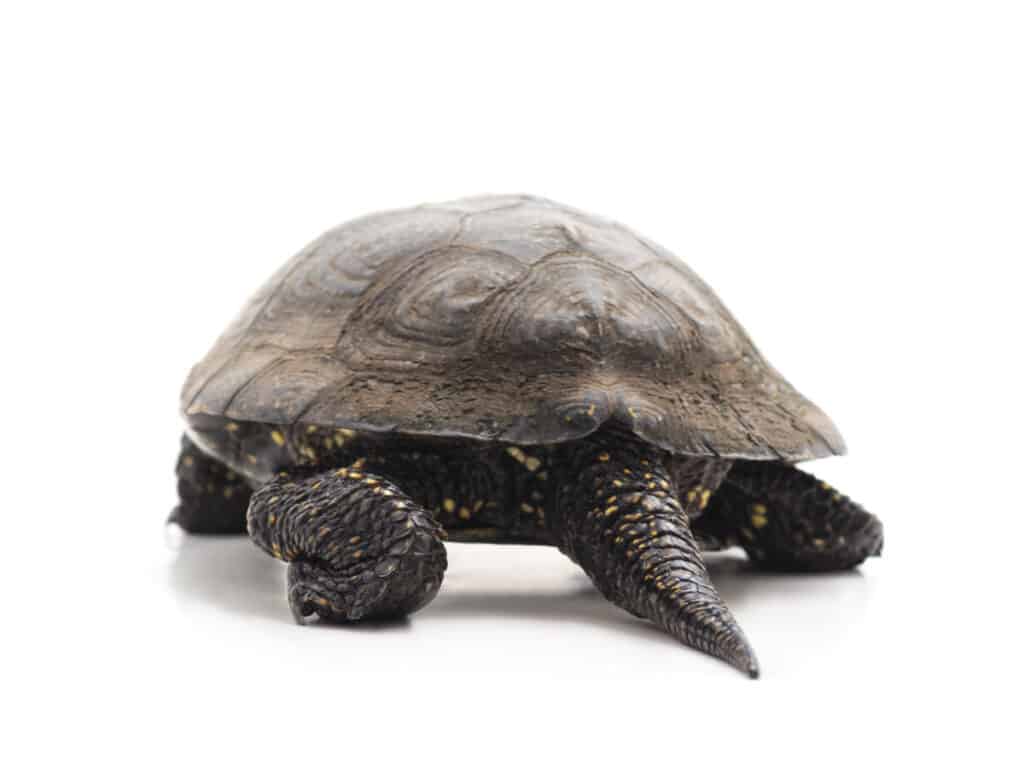
Most animals have tails for different roles. For example, leopards and cheetahs have flexible tails that help them maintain balance when chasing their prey. In fish, the tail helps them change direction, a mechanism used in submarines and aircraft. But what about turtles – one of the oldest and most primitive reptiles? Do they have tails?
Yes, all turtle species have tails. The tail is primary used for protection and mating, with its length varying from one species to another and by gender. Male turtles tend to have longer and thicker tails compared to their female counterparts. Female turtles use their tail to help their male counterparts locate the cloaca. Therefore, in females, the tail hides and protects the vents of their cloaca.
Tails in female turtles are short and do not play a significant role, apart from hiding the cloaca, which explains why it’s smaller than that of male turtles.
Still intrigued by turtle’s tails and how the male turtles use them for reproduction? We discuss this and much more.
Keep reading!
How Do Turtles Use Their Tails?
A turtle’s tail is an integral part of its body structure. Although turtles do not use their tails for swimming in the water like other aquatic animals or balancing like land-dwelling creatures, a turtle’s tail is important for several reasons.
A major role of the tail is in the mating process. Without the tail, turtles cannot mate and reproduce. They also use their tail for protection.
Let’s look into these two roles and several others in greater depth.
Four Purposes of a Turtles Tail
To Mate and Reproduce
Unlike aquatic creatures such as fish, turtles do not use their tails to navigate in the water. Tails in males are designed for mating and reproduction.
Upon reaching maturity, the tail of the male turtle grows at a rapid rate. In fact, the male turtle’s tail can grow longer and extend beyond its flippers.
The male has a cloaca under its tail on its bottom. When mating, the rest of the tail keeps the female in position and blocks other male turtles that may try to mate with the female during that time.
The cloaca serves four important roles – urination, execration, breathing, and reproduction. Turtles use this one orifice for all these purposes.
The cloaca is also found in other animals and thus is not only found in turtles. Most bird species and some fishes have cloaca too. However, in other animals, the cloaca doesn’t serve as many purposes as in turtles. Turtles use their cloaca for breathing, something other animals with cloaca don’t do as they don’t have a reason to do it.
In turtles, the cloaca has Urodeum, which is connected to the ureter, to help in urination. There is also Proctodeum and the Coprodeum.
In females, the cloaca acts as an outlet for eggs. In addition, it is used for defecation and urination.
It is important to mention that the tip of the tail is sensitive for both sexes. The sensitivity of the tip helps the male figure out when its reproductive organ touches the female’s cloaca.
Turtles struggle to mate as the male finds a hard time locating the female’s cloaca. It is easy to see why the male turtle struggles to locate the female cloaca, considering their doom shape. However, once it figures out the cloaca location, it releases its sperm, which then navigates to the female womb.
Female turtles, on the other hand, do not have their reproductive organs located in their tail. Instead, they use the tail to cover the vent of the cloaca. By raising its tail upward or sideways, the male turtle is able to penetrate its reproductive organ into the cloaca to release sperms.
For Protection
Although the hard turtle shell acts as its first line of protection, the tail also protects them. When in the wild, turtles encounter different surfaces, including slippery ones. The long tail helps the turtle to balance themselves. In addition, the tail anchors them to the rugged terrain and rocks.
In female turtles, the tail protects the cloaca vents. The vents are the vaginal opening where the male deposits its sperm during mating. In addition, the vents act as pathways through which the eggs come out. In addition to protecting the vent, the tail in female turtles gives them a firm grip on the ground.
Serves As an Additional Flipper
After laying eggs, turtles have to hide them under the sand to protect them from predators. How do they dig holes? They flipper their legs and hide the eggs in a way that doesn’t look conspicuous.
While moving the legs, the tail also does some leveling. Although this may not be its primary purpose, it still helps.
So, yes, those are the primary roles of a turtle’s tail. But what if the turtle loses its tails due to injuries caused by predators – can it regrow, and can a turtle survive without a tail. Let’s talk about this.
Can Turtles Regrow their Tail?
Although some reptiles, such as lizards, regrow their tails, turtles don’t fully regrow their tails. Therefore, if the turtle’s tail gets injured or cut off, all you can do is nurse it with medication to heal. However, it will not regrow as much. Even lizard’s new grown tails aren’t as long as the originals.
Why Is My Turtle Not Growing A Tail?
Some turtles are not able to grow their tails due to their genetic disposition. At times, the baby turtle may not be able to develop a tail as it isn’t mature enough.
All turtles have tails, but they do not form in their early years – they will only grow once they reach sexual maturity.
The females tend to have a shorter tail than their male counterparts as their tail only protects the cloaca, whereas their male counterparts have a tail that serves as a reproductive organ.
Therefore, if your turtle has no tail, it means it isn’t fully developed, and therefore you should give it time to reach maturity. The tail will protrude once it gets to the adult stage (after 6 or 7 years).
Which Turtle Species Has the Longest Tail?
Snapping turtles are known to have the longest tail in the turtle’s family. Their tail is robust and helps to provide stability to their body when they are ascending on land.
Can Turtles Retract Their Tails Inside Their Shell?
Freshwater turtles tend to retract their limbs, head, and tails back into their shell, but some turtle species can’t retract their tails inside the shell.
Do All Turtles Have Tails?
Yes, all turtle species grow tails. Snapping turtles have the longest tails, and in some cases, the tail can be longer than the carapace and is protected by bony plates.
Male turtles have thick and long tails. Their vent is located underneath the tail. In contrast, mature female turtles have short and skinny tails that only protect their reproductive organs.
What Is That Black Sack Coming out of My Turtle’s Tail?
Pet turtle owners may be alarmed to find a dark grey, black, or purple sack protruding from the underside of their turtle’s tail. However, this sack-like organ shouldn’t worry you unless it persists.
It serves as the reproductive organ of the male turtle, mostly hidden within the cloaca until the mating time comes. If you happen to see the organ coming out from the underside of your turtle, you can be confident that it’s a male turtle.
Let’s talk about this in greater depth:
Turtle Reproductive System
Turtle’s reproductive anatomy is quite complex, and it’s hard to differentiate a male from a female turtle at first glance. This is because the male turtle reproductive organ is usually tucked into the cloaca, a vent found on the underside of the tail, which serves as a reproductive organ in both sexes as well as a urination and defecation outlet. The cloaca is more extensive in males since it serves as a penis as well.
Biological Mechanism
Like other animals, male turtles have a hydraulic intromittent reproductive organ, meaning that when the male turtles want to mate, it becomes physiologically aroused and blood fills the collagen fibers inside the erectile tissue of the organ to cause an erection.
Their reproductive organ protrudes from the cloaca in male turtles, first underneath the tail and then alongside the tail. As the organ keeps expanding, it grows vertically under the body.
Why the Male Turtle Reproductive Organ Comes Out of Its Tail and When It Becomes a Cause of Concern
There are several reasons the male turtle’s reproductive organ protrudes from its cloaca, with the main reason being the preparation for mating with a female.
However, there are other reasons why a turtle’s reproductive organ may protrude from the cloaca, including when it is agitated or excited. Also, the turtle’s reproductive organ may come out if it has muscle control issues, has an infection, when urinating or defecating, and if it has constipation.
When Should You Be Concerned?
In many cases, there is no cause of concern when a male turtle’s reproductive organ comes out of its tails, as long as the turtle can retract it back.
Sometimes, however, the turtle is unable to retract its male organ due to swelling or injuries. This is what we call prolapse.
If the turtle cannot retract its phallus, then it faces the risk of dying if the sensitive organ will not be attended to.
Therefore, monitor your turtle to see if it will be able to retract its reproductive organ back into the cloaca on its own. If this doesn’t occur, consult your vet. Also, if it’s in the company of another turtle, remove him from there to avoid other turtles scratching or biting it as this will worsen the problem.
Why Is My Turtle Bleeding From Its Tail?
If you notice your turtle’s tail bleeding, you should look for signs of cuts or injuries. In case of visible signs, this could indicate an underlying condition such as cystic calculi. The condition is characterized by blood-stained droppings, which explain why you see blood in the tail as well as the underside of your turtle.
It’s important to mention that cystic calculi don’t have any correlation with your turtle’s tail. The disease, which is often called bladder stones, occurs when crystals are formed in the urine. In turn, the crystals stick together to form stones. Majorly, this is due to diet-related issues or dehydration.
Cystic calculi is considered a severe medical condition requiring fluid therapy and surgery to prevent the kidney’s impact. The best way to prevent the disease is to ensure your turtle is feeding right and is in a hygienic environment.
Why Is My Turtle’s Tail Swollen?
Unexpected swelling on any part of the turtle’s body should raise a cause for alarm. Swollen tails in turtles might be caused by several things, including inflamed cloaca, local trauma, or a generalized health issue.
In most cases, you’ll find the underlying problems caused by changes in temperature, exposure to UV light, water quality, or minor nutritional excesses or deficits.
If you observe the turtle’s behavior changing due to the pain or discomfort caused by its tail swelling, you should take it to a local vet and discuss how to handle the issue.
Can I Pick a Turtle By Its Tail?
You should never pick a turtle by its tail, as this can dislocate its spine, causing it to die a slow, painful death.
If you want to pick a midsize or large turtle, approach it from the back to avoid seeing you coming. Also, avoid loud noise. Wear heavy gloves for additional protection and to have a better grip.
After that, grasp your turtle by the back of the shell as your other hand supports the side. Ensure your hands are behind the back legs and have a good grip before lifting.
Lift the turtle and keep it far from the body. The head should be in line with the body – not up or down.
Also, avoid turning the turtle too quickly as its organs can twist and flip. Turning the turtle through a full 360 degrees will result in twisting the intestines.
Conclusion
Turtles use their tail for protection and reproduction. The size of the tails determines the gender of the turtle. Male turtles have long, thick tails, whereas their female counterparts have short tails.
Their tails cannot completely regrow when cut, but the scar vanishes after healing. Overall, turtles can survive without a tail, but they will tend to struggle swimming or ascending uphill.