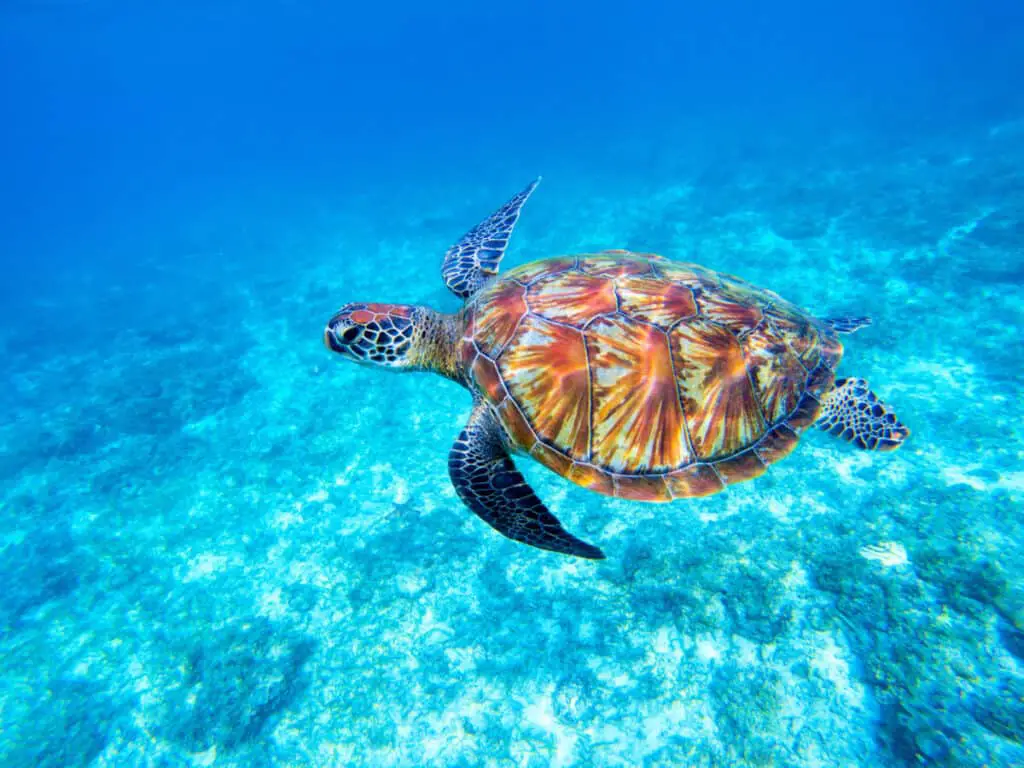
Turtles won’t eat on the land: they prefer to do it the water. That’s because turtles need their food moist to swallow. So, if you have been feeding them off the ground or in their basking areas, you are doing it wrong and probably the reason for poor feeding.
It’s mainly aquatic and semi-aquatic turtles that need water to swallow. Most terrestrial species can comfortably eat even when you offer them food on the ground. Eating in water tends to pollute the same water they live in, but it turns out that water is deeply tied to a turtle’s digestive system. This phenomenon has resulted after years of evolution.
Why Do Turtles Need Water to Swallow?
Turtles require water to swallow food due to the lack of saliva. And since they also lack teeth, they cannot break down their food and have to rely on water to gulp the food down the throat. The practice can be clearly observed in Red-Eared Sliders and Painted turtles. Even if you gave them food while on the ground, they quickly jump into the water to start eating it. Usually, turtles will put enough food in and blow the water to swallow.
Besides, turtles go to the water to hydrate their papillae, which is useful for swallowing food. If you are asking what papillae are, these are little bumps on the tongue. In animals, papillae assist with moisturizing the tongue. Dogs use it to heal their wounds, whereas cats use them for grooming.
Aquatic turtles have lack papillae and smooth mucosal surfaces. That, combined with their poorly developed palatine glands, is the main reason they require water to swallow food. Semi-aquatic turtles, on the other hand, have short glandular papillae and a more superficial mucosal surface. Examples of semi-aquatic turtle species include clemmys guttata, which also require water to swallow. Terrestrial turtles have longer and thicker papillae and will sometimes swallow moist food without the water.
How Do Turtles Feed Underwater Without Taking In Too Much?
Because turtles have to push the food down their throat using water, you might ask how they avoid swallowing too much water in the process. Well, a turtle’s esophagus near their throat is highly evolved with long projections known as papillae. The esophageal papillae are muscular facing towards the stomach filter food and water. When they constrict, the food (bolus) is pressed to the stomach as water is expelled water out of the mouth. Only a tiny proportion of swallowed water is swallowed and enters the digestive tract.
How Do Turtles Eat Underwater?
As for fish, water is as good as air for humans. We do not stress swallowing air as we eat. But how do turtles eat underwater without swallowing too much water? Well, turtles have adapted to eating underwater. They just extend their head and literary suck the sponges, algae, cucumbers, and jellyfish.
The sucking is similar to slurping noodles. They can easily restrict the entry of water into the trachea, just like how we do when we eat or drink. The suction they create helps to keep the prey in the mouth. They achieve this by expanding the back of the throat and depressing the hyoid bone, hence lowering the bottom of the throat.
Once the food enters the mouth, the turtle expels the water by raising the tongue to hold the prey between the tongue and the upper jaw. At the same time, they can compress the mouth to expel water between the slight gap left between its mouth and nostrils. Besides, experts have observed that after the turtle has the prey inside the mouth, they release a jet of water through the nostrils and the mouth.
There’s still some water left in the mouth to aid swallowing. Most studies also note that turtles can’t swallow their food outside water, indicating that they depend on it to swallow. They lack complex salivary glands like us. They just have one gland, and it’s significantly reduced. This has led to the conclusion that their salivary gland only serves with releasing digestive enzymes and no lubrication.
Once the food goes down the throat, it progresses down the esophagus with long conical projections known as papillae. They are oriented towards the stomach and prevent the bolus from going back when squeezing out the leftover water. The structure appears like a very bizarre tube with muscular inward-facing spikes.
The papillae are also crucial for turtles that live in salty water. They act as filters as the bolus moves over them by squeezing out the water and salt.
Why Should Turtles Get Rid of Excess Water When They Swallow Food?
Well, although turtles spend most of their life in salty ocean water, too much drinking would be disastrous. If they took too much salty water, it would disrupt the ions in the cells and alter the delicate balance needed for the chemical environment of DNA and proteins. Turtles get most of the water from the food they eat. In a single drink, they can swallow an impressive amount of water that can quench their thirst for quite a while.
Why Do Turtles Poop In Water?
Turtles don’t just poop in water; they also prefer doing it there. This is because water relaxes a turtle’s bowel, which encourages easy movement of poop.
Do Land Turtles Need Water to Swallow?
Like their aquatic counterparts, land turtles lack salivary glands. Thus, they cannot swallow and digest without water. However, they don’t have to dip their heads in the water as aquatic turtles do.
What’s the Right Way to Feed a Turtle without Creating a Mess?
Food particles are the real danger to the turtle’s aquarium—these small pieces of food break when the turtle bites, and they can be small. Over a short time, they can pile up and make the water dirtier. There’s only one way to deal with this, and that’s to feed the turtle in a different container.
Just fill the different containers with water specifically for feeding the turtle. When it’s feeding time, place the food and turtle in the tank and leave it to stay for about 15 minutes before taking it back to their normal aquarium. You might have to wait for more minutes to allow the turtle to defecate in the same container so that you can just throw the water away when you are done.
The method is practical and straightforward. Just ensure you don’t use the container for anything else because it might harbor salmonella. Avoid placing your foodstuff on the containers as the bacteria can make humans ill. Using a separate container for feeding will save you time because you won’t have to clean the tank often.
How Often Should You Clean a Turtle’s Tank?
You must clean the turtle’s tank at least monthly, depending on the strength of the filter used. Experts and vets recommend cleaning the weekly and performing partial water changes to maintain high water quality.
Many keepers recommend feeding the turtle in a separate tank from the one they live in. This is mainly helps to prevent leftovers, which can foul the tank. As a result, less cleaning is required. Also, you can use a net to scoop up the leftovers.
Regular partial water changes, scrubbing the algae on the side, and vacuuming the gravel will negate the need to completely clean the tank, especially if you have a separate enclosure for feeding.
How to Keep the Turtle Aquarium Clean
Here’s the likely scenario for you: you just became the keeper of a new turtle, but the tank water is turning dirty really quickly and now smells terrible. No matter how much you try to keep the water clean, the pet makes it incredibly dirty again. Since this is the same water the drink, you are guilty that it appears and smells bad.
Regular maintenance is critical in preserving a clean tank. There are a few innovative ways to keep the turtle tank clean. Here are ways to keep a turtle tank clean and sanitized.
Look for a Strong Filter.
A great way to maintain the quality of water in a turtle tank is by setting up a strong canister filter. Due to their messy nature, aquatic turtles need turtle-specific canister filters. These are larger than your typical filter and have a more robust water filtering capacity. They are recommended for aquariums overstocked with fish and aquatic turtles.
Canister filters can pump and filter massive volumes of water with additional biological purification through the trays that contain a variety of filter media. Having such a device in your setup is a sure way to keep the tank water clean for more extended periods significantly.
Vacuum the Food Leftovers Regularly.
Turtles are messy eaters, too, and the food particles they drop can pile up with time, creating a stinky environment of ammonia. Turtles suffer from a higher concentration of ammonia and could become severely sick. To avoid this, you need to ensure the aquarium gets vacuumed regularly to remove any form of organic matter that’s not utilized.
If left to accumulate, a special set of bacteria starts thriving in the aquarium, mineralizes food leftovers, and converts them to waste. Then, another bacterium takes from this and converts the ammonia to nitrite. The cycle ends when the nitrites are converted to less harmful compounds.
You can avoid the chemical fluctuations by cleaning the tank and vacuuming it regularly. Vacuuming is easiest when you use a unique hose-like gravel vacuum such as the one used for fish aquariums. If unsure, look for one with an extended nozzle to provide a convenient reach. Shorter ones are annoying and less effective.
Additionally, make sure you look for one that’s BPA-free to avoid leaking harmful substances into the turtle’s tank. Note that if the canister filter is strong enough, it reduces the vacuuming, depending on how many turtles the aquarium holds. The filter has special internal media that gets colonized by colonies of beneficial bacteria. This can significantly improve the water by breaking down the turtle waste.
Keep Track of the Chemical Levels
Turtles are sensitive to chemical changes in the water they swim in. these changes often occur long before you start noticing any odor or discoloration in the tank. The only way to stay ahead of the chemical change is by keeping track of them using water test kits. These are designed to indicate various chemical levels in the sample water. A clean aquatic turtle tank should have a pH of 6.0 to 8, a chlorine level of zero, and a nitrate level below 40 ppm. The ammonia level should be at 0 and nitrate level of 0.5ppm or less. You can test the tank chemical levels weekly and clean out the water if you notice any drastic changes in any of the chemical levels.
Aerate the Water
Aerating the aquarium increases the amount of fresh air flowing through the water, removing odors, and the oxygen discourages bacteria growth in the tank. Most of the bacteria that invade your pet turtle’s environment are anaerobic, making aeration a cheap and efficient way to get rid of them. You can use an aquarium air pump to push air down a pipe and into the aquarium. Your turtle will also enjoy playing around with the bubbles.
Introduce Helpful Fish
Some aquatic creatures such as ghost shrimps and plecos will keep the water tank clean by scavenging for leftovers and feeding on the algae. These working fish help maintain a natural balance in the aquarium by eating the tiny scraps that harbor harmful bacteria.
Remember to add extra rocks at the bottom to act as hiding places for the small fish, or your turtle will just eat them all in no time. The small fish are also recommendable as they are protein-rich food sources for your pet turtle, and they get to exercise while hunting and hunting down the shrimps.
Sterilize the Water with UV Light
Turtle aquariums are likely to harbor free-floating pathogens. Also, this type of water sterilization is not achievable through the UVB lamp your turtle uses for basking. That’s why you may need to invest in a quality UV water sterilizer. When the aquarium has accumulated too much organic matter, it becomes cloudy or green. This is an indication of present single-celled organisms or bacteria. With an abundance of unutilized food sources, the organisms begin to multiply.
In a turtle tank, green water is mainly caused by microalgae spores, while white water is likely caused by free-floating heterotrophic bacteria. These conditions are not suitable for the turtle and could produce a foul smell, which is not good to have at home.
The water will eventually find balance and clear itself when the nitrogen cycle is complete. However, the turtle may become vulnerable to;
- Shell infections
- Damaged eyesight
- Digestive difficulties
- Skin infections
- Respiratory diseases
- A yellow build-up in the ears
- Parasitic worms
A UV water sterilizer is therefore necessary, although it should be used only when needed (during an outbreak). Treating the turtle tank with UV light can wipe out free-floating algae and pathogens quickly. A powerful UV sterilizer can address the problem in a matter of days and is an effective way to eliminate the foul smell in the aquarium.
Change the Water Regularly.
Even if you’ve been cleaning the water in the aquarium, nitrates will keep accumulating from the nitrogen cycle when nitrites break down. The nitrate is harmless for turtles in the short run. However, it builds with time and could remain in the water for too long, which may harm the turtles.
By replacing the water in the aquarium with dechlorinated water, you dilute the excess nitrates. Avoid tap water as this may contain chlorine, which is toxic for turtles. Besides, chlorine kills both good and bad bacteria, which is why most turtle owners use UV sterilizers. As a result, always dechlorinate the tap water to ensure the beneficial bacteria thrive in the aquarium. If you are asking how to dechlorinate water, use a water conditioner. Don’t count on the aquarium filters to get rid of nitrates, so you need regular water changes.
Get a Bigger Tank
A small tank can only hold a limited volume of water, making it much easier for turtles to dirty. Having a small tank also impedes your pet’s growth by limiting the amount of space to swim and get enough exercise. Getting a bigger tank will increase the amount of water your turtle has to play around in and poop in without the entire tank stinking up before it’s time to change out the water.
Bigger tanks are also more likely to be equipped with biological filtration systems that filter out ammonia. These filters have friendly bacteria that digest the ammonia, but they require enough water to dilute the ammonia concentration. Keep in mind that although turtles grow slowly, they do get bigger over time so getting your pet a bigger tank is ultimately the best solution.
Add Floating Plants
Aquarium plants also keep the water clean by utilizing ammonia and nitrate as food. This not only keeps the turtle safe but will also reduce the need to clean water regularly. The reason why floating plants are preferred is that they have a broader reach to more atmospheric CO2, which is needed for nutrient exchange processes. Submerged plants absorb less CO2 and end up sucking fewer nutrients from the water.
However, you should be mindful of the plants because some can be toxic to turtles. some good plants for a turtle aquarium include:
- Dwarf Duckweed
- Water Lettuce
- Hornwort
- Amazon Frogbit
- Giant Duckweed
Use a Gravel Vacuum to Remove Debris
If your turtle spends most of the time in the enclosure, ensure a gravel vacuum is in place to suck up any debris that could be trapped underneath them. A gravel vacuum is important in one major way: it helps maintain the water quality remove the waste before breaking down. Not only can this lead to a darkened enclosure, but poor water quality keeps the turtle susceptible to a variety of health issues. The benefits of a gravel vacuum in a turtle enclosure cannot be understated.
Have a Strict Feeding Schedule
If a turtle tank offers a constant supply of plants and other vegetation to munch on, it’s advisable not to feed more than twice a week. Adults should eat less protein, which juveniles may need for growth. One of the best practices for ensuring clean water in the aquarium is to feed the turtle just enough. Overfeeding is a major cause of dirty water in a turtle tank. You can reduce waster by feeding the juveniles three nutrient-rich meals per week. Adult turtles can manage with one or two meals a week.
This will depend on the food you provide. For example, greens offer fewer calories, hence little waste. Fish and other protein-rich foods are densely packed with nutrients.
Add Friendly Bacteria
If your turtle’s aquarium is always smelly, even while the water is still clean, you can introduce friendly bacteria to get rid of the odor. Pet supply stores do stock up on starter cultures that also eliminate chlorine and ammonia from the water. These water cleaners are also packed with enzymes that dissolve turtle poo and leftover particles which eventually get filtered out of the tank. Keep in mind that turtle additives are different from fish supplements which often contain chemicals to kill algae and are quite harmful to turtles.
Wrap Up
So, turtles need water to swallow, but they do not swallow excess. Unfortunately, they drink the same water where they defecate, so you must ensure the tank stays clean to avoid sicknesses.
Having a clean water source for your pet turtle to drink from and play in will go a long way toward supporting their growth.
Regular cleaning and investing in quality filters are some of the ways you can maintain your turtle’s water tank, which dramatically improves their life even in captivity.