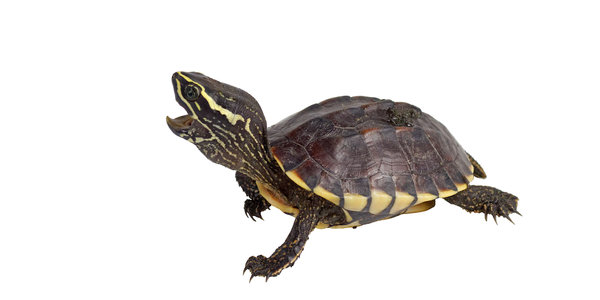
Turtles are slow-moving creatures, and most of us associate them with the hard shells they carry. They occupy various habitats such as land, aquatic and semi-aquatic habitats. Turtles also feed on a wide diet depending on the species; as such, we can’t help but wonder, how do turtles eat?
Do Turtles Have Teeth?
No, turtles don’t have teeth. It is a fact that also applies terrapins, the semi-aquatic turtles, and tortoises, the land-dwelling turtles. Instead, they have beaks, just like birds. Some of their beaks are serrated, and the edges act as teeth. Other turtles lack a beak and instead have soft lips for swallowing the food whole. However, baby turtles have an egg tooth, a modified scale, and not a real tooth.
Even though modern-day turtles do not have teeth, research discoveries show fossils of turtles’ teeth. The toothed turtle, or Odontochelys as it is commonly known, was in existence millions of years ago. These fossils indicate that the ancient turtles have teeth on both jaws.
Although not tooth-like that of humans and other toothed animals, baby turtles are born with an egg tooth, also known as a caruncle. It is a single tooth at the front part of their upper jaws. They use it to break out of their shells during hatching. It, however, falls off within the first few months of the turtle’s life.
Teeth are vital in animals as they help them bite and chew food to tinnier bits. It not only makes swallowing easier but also reduces the risk of choking. In addition, they also enhance the animal’s appearance. So in the absence of teeth, how do turtles eat? Let’s dwell on this and more questions on turtles and teeth.
Do Sea Turtles Have Teeth?
There are about seven distinct sea turtles species worldwide, and most of them, such as loggerheads and green sea turtles, are carnivorous, meaning that they only feed on meat. Meat requires more energy to bite, cut, and chew than most plants, fruits, and vegetables. Thus, it is possible to wonder if sea turtles have teeth to make these functions easier.
Sea turtles do not have teeth. Instead, they have strong jaws and sharp beaks. These sharp beaks help them bite the prey or crush the shells of crabs and mollusks. The strong jaws exert pounds of pressure enabling the sea turtle to grasp their prey without the prey escaping and crushing them. In addition, they help them bite off chunks of their fleshy prey into bite sizes.
The leatherback species is one of the most popular sea turtle species. They are known to traverse miles away searching for their favorite snack; jellyfish. Jellyfish are slippery, and they can sting. It requires special features for one to catch them.
Leatherback sea turtles have spikes in their mouth in addition to the sharp beak. The spikes enable them to grasp and hold the slippery jellyfish without getting stung.
Other turtles with hundreds of spikes in their mouth include loggerheads, green sea turtles, and olive ridley species. Though necessary for their feeding and survival, the spikes make these turtles look scary.
Further, sea turtle species such as green sea turtle and the hawksbill species have a serrated upper part of the beak. It helps them cut their prey more effectively and into tinnier sizes for swallowing.
Do Turtles Have Beak Or Teeth?
Turtles have a beak and not teeth. Even so, baby turtles are born with a modified scale known as an egg tooth. They use it to crush the egg once the incubation is over to get outside. Baby turtles do not use for eating. This tooth, however, doesn’t last long as it sheds off a few months after hatching.
Even though modern-day turtles don’t have a tooth, research shows that ancient turtles existed over 200 million years ago and had teeth on the upper and lower jaw. The reasons for the evolution of the lack of teeth in the present turtles are unclear.
A turtle’s beak varies in shape depending on its diet. Carnivorous species have a sharp pointed beak, while herbivorous species have a short and broad one. Since omnivorous turtles eat both plants and animals, their beaks are a blend of the two; not too long and not too short.
What Do A Turtle’s Teeth Look Like?
A baby turtle’s tooth features different materials from regular teeth. It comprises horny tissue and is located near the tip of the turtle’s beak. It is temporary and sheds off after hatching.
How Do Turtles Eat?
Now that we know that turtles don’t have teeth, you must be wondering, how do these docile animals eat? Do turtles chew food? How do they eat? We get to cover all that in this section.
A turtle’s diet comprises plants, vegetables, fruits, and proteins such as meat, fish, insects, and pellets, depending on whether the species is carnivorous, omnivorous, or herbivorous and, at times, whether they are juvenile or mature. Turtles feed on these items without teeth, so how do they do it?
Most turtle species have a beak like a bird. It is powerful but has an odd shape. They use it for tearing apart, biting, and chewing the foods they ingest, especially meats. These sharp beaks grow continuously throughout the turtle’s life. Some turtle species can live for over 100 years, so the beaks continue to grow for such long lifespans.
Some species, such as the green sea turtles, possess ridges with serrations on the inner side of the beaks. These sharp ridges function like teeth, enabling turtle species to tear or scrape off items on hard surfaces of things they come across in the ocean.
It is possible to tell a turtle’s diet by looking at its mouth.
The beak of a carnivorous turtle species is horny and hooked. Its shape allows the turtles to pierce, crush and kill their prey. It is an essential feature as these turtles almost entirely feed on meat.
When it comes to herbivorous turtles, their beaks are short, broad, and flat. The adaptation helps them cut and mash fruits, vegetables, and plant matter, which is the most significant part of their diet. Like the green sea turtles, herbivorous turtles’ beaks are serrated towards the edges, forming cusps that act as teeth in other animals.
On the other hand, omnivorous turtle species have powerful jaws with enough pressure to crush other hard-shelled animals. They exhibit a mix of the carnivorous and herbivorous species with pointy beaks but not as pointed as carnivorous turtles.
The powerful muscles enable the turtle to exert a lot of pressure on what they are biting and cut the food into small pieces. Loggerhead turtles and the snapping species are some of the turtles with the most powerful jaws. The jaws are so powerful that they can amputate the human finger.
Upon cutting the food into bite-size pieces, the tongue moves these pieces to the back of their mouths for swallowing.
Not all turtle species use a beak to eat. Soft-shelled species have soft lips instead. They do not chew food and rather swallow it whole by sucking it into the mouth then using the tongue muscles to swallow it. It is a phenomenon that also applies to most sea turtles, who are generally carnivorous.
Other turtle species use their tongues to lure prey underwater into their mouths. They then close the jaws around the prey before swallowing them whole. Such prey includes small fish, clams, crabs, and sea urchins.
Besides eating, turtles also use their beaks for protection from predators. Some of these slow-moving creatures use other defense mechanisms like retracting in the shell or emitting a foul smell.
How Do Turtles Bite?
Even though they lack teeth, turtles can still bite. Cases of turtles biting people or other animals, including fellow turtles, and causing severe wounds are not unheard of. In fact, some species have a powerful bite that exerts pounds of pressure enough to cut a human’s finger.
Turtles hardly bite, but they can do so when you scare them or get too close, and it is often painful. They may also bite if they confuse your hand or fingers with food. It is essential to protect yourself from turtle bites both at home and in captivity when helping them to cross a road.
Some of the protective measures to use in captivity are feeding your pet turtles from a dish and not using your hands, giving the turtle a suitable habitat to eliminate chances of aggression, and monitoring your pet turtles’ behavior for any signs of aggression mannerism.
Carnivorous species tend to cause the most powerful and painful bites. Their jaws and beaks are adapted to crush hard shells, and they often feed on meat. Some of the turtles most likely to bite include the alligator snapping turtles, common snapping turtles, musk turtles, and some slider species.
Besides biting you, a turtle might also bite another turtle, especially if they share a tank. Some bites can be fatal, while others are playful, especially during mating. Some of the reasons your turtle might bite another turtle to the extent of excessive breeding include hunger, territorial fights, stress, and fighting over a mating partner.
There are also cases of turtles eating each other, so you should not ignore issues of aggressiveness among your pet turtles.
Here is an article about Traumatic Amputation of Finger From an Alligator Snapping Turtle Bite.
Frequently Asked Questions
Do Tortoises Have Teeth?
Tortoises are turtles. They are turtles that live entirely on land and would not survive underwater.
As with all turtles, tortoises do not have teeth. Instead, their mouths have a strong and sharp edge that acts like a beak in birds. It helps them cut and bite their food. Even so, tortoises that existed over two centuries ago had teeth on both jaws.
Are Turtles Dangerous?
In general, turtles are harmless animals. They often retract in their shells when you touch them or when they detect prey. However, some species cannot retract in the shell and might bite as a means of self-defense.
Other than when provoked, extreme stress, or starvation, turtles are peaceful reptiles.
Does A Turtle’s Bite Hurt?
Yes, they can be painful. It is easy to think that turtles can’t bite because they don’t have teeth. However, these creatures are not entirely harmless. Even though they don’t have teeth, turtles can bite, which can be pretty painful.
The turtle’s sharp beak and powerful jaw make a strong combination that can lead to excessive bleeding and cause a deep wound. Carnivorous species have the most hurtful bites because they have naturally adapted to biting and chewing meat.
Which Is The Turtle With The Strongest Biting Force?
The common assumption is that the common snapping turtle has the strongest bite. While this turtle species has a strong bite, common snapping turtles do not have the most powerful biting force.
Alligator snapping turtles bear the most potent biting force. It measures 1000 pounds of pressure. The pressure is strong enough to crush any bone in the human body, and as such, you should be careful when handling an alligator snapping turtle. The force is necessary because these turtles primarily feed on snakes, snails, clams, and fish in the wild, which may require a lot of force to grasp and crush.
Conclusion
Turtles are intriguing creatures, from their appearance with a hard shell to how they eat. Eating is as important to turtles as to other animals; it keeps their health optimal and helps them fight diseases. To the shock of many, turtles do not have teeth, and they use a beak to eat. Even so, baby turtles have a tooth they use to crush the egg during hatching, and this tooth sheds off after that.
The mouth of a turtle has a protrusion like a beak in birds. Its shape differs depending on what they eat. Meat-eating turtles have a sharp, long beak, while plant-eating turtles have a short more flat beak. Turtles species that eat both plants and meat have a beak with features of the two.
We trust that this has helped you understand turtles better and how they feed. Remember to not bother these slow-moving creatures as they can bite, causing serious wounds.